
 Mike Hale
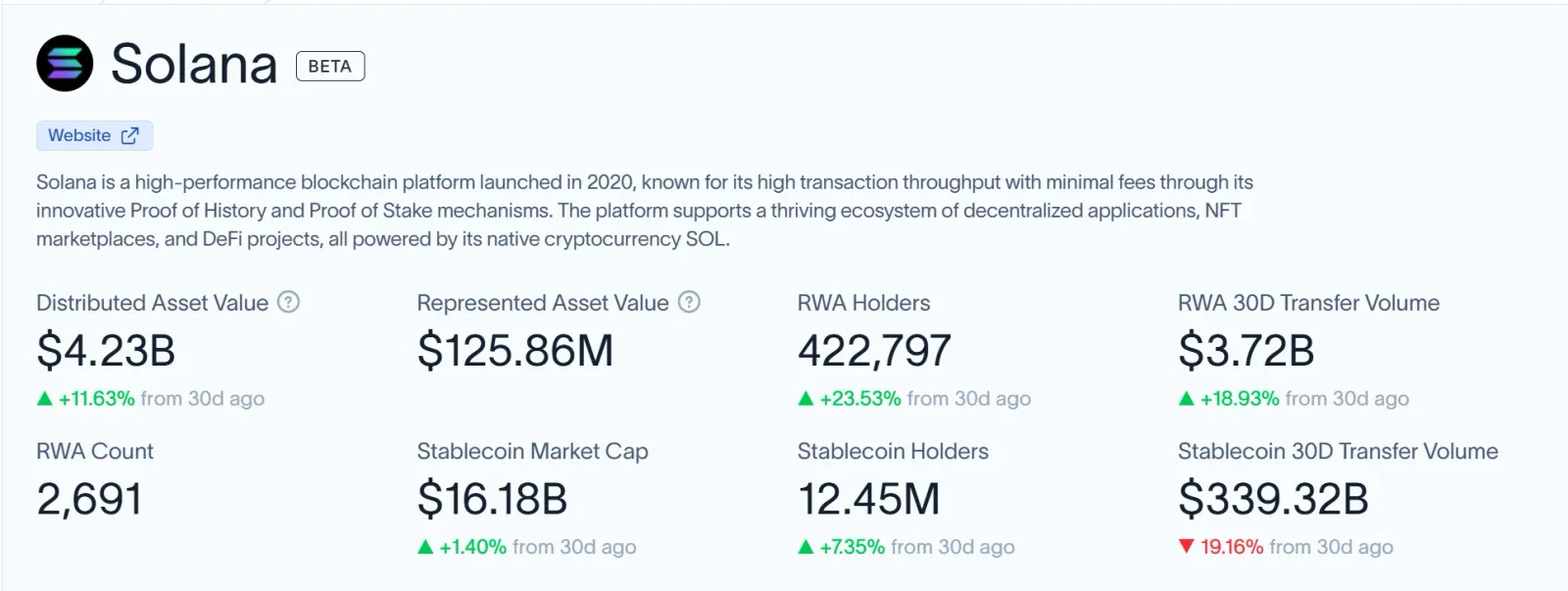
 Solana Foundation president Lily Liu published a CoinDesk column on September 2 arguing that tokenization is a decades-long "token supercycle." The receipts stacked underneath the argument are Solana's own. The network holds $4.23 billion in non-stablecoin real-world assets and $16.18 billion in stablecoins, according to RWA.xyz.
The column is framed as a thesis about capital markets, and Liu argues that tokenization changes who can issue an asset, who can invest in it, and who can distribute it, all at once, and that the winner is whichever network those three sides converge on.
The numbers behind Solana's pitch
Solana's lead in tokenized assets is real and it's concentrated in two places, trading activity and payments rails.
The Solana RWA Ecosystem report from Allium, published September 8, backs that up on the trading side. Solana executed 32% of onchain RWA spot volume in the 12 months to August 18, $14.7 billion of the $46 billion traded across the 24 chains tracked, and it ran 47% of the trade count at 42.6 million of 91 million trades. Tokenized equities are its largest class by volume, and there it executes 31%. That class has grown fast, from $775 million in the back half of 2025 to $4.9 billion in the first half of 2026.
That 31% splits hard by venue. Solana handles 45% of the tokenized-equity volume that trades on decentralized exchanges and 2% of the volume on issuers' own platforms, almost all of which is Ondo Global Markets, where the issuer fills orders at its own price. Ondo lists 264 tokenized equities and ETFs and has passed $1 billion in total value locked, so the venue Solana barely touches is a big one. A narrower reading from Pine Analytics put Solana at roughly 97% of tokenized-equity spot volume in May 2026, counting decentralized venues over a single month. The wider the window and the venue set, the smaller Solana's share gets.
Today the market is spread across chains rather than converged on one. Fifteen of the 24 chains Allium tracks recorded RWA spot trades over the year, and Solana carried about a third of the volume. That 2% share of issuer-platform volume points the same way, with a large slice of activity running inside venues the issuer controls rather than in shared liquidity.
Liu's position is that this is a waypoint. She argues that a network fast enough and cheap enough to carry real economic activity ends up hosting consumer payments, institutional settlement, and global markets on the same rails, and that Solana's low costs and shared liquidity are what let those use cases deepen and compound in one place instead of fragmenting across separate markets.
Allium's findings land directly on Liu's argument:
63% of Solana's tokenized-equity volume trades while US exchanges are closed
Weekends alone account for 17% of the year
That's her round-the-clock claim measured rather than asserted.
The other finding is about ownership. Solana holds 20% of the wallets that own RWAs against 12% of the market cap, roughly 1.8 times more owners per dollar held than the rest of the market. The average position is $14,000 against $27,000 on other chains, and the median RWA trade is $29 against $70. Maple's tokenized private-credit fund shows the same split inside a single product, where the median trade is $24 on Solana and $1,257 everywhere else. Liu argues that check size stops being a gate once an asset is tokenized, and that is what these numbers show.
On payments, four established payments companies are running production flows through Solana.
Company | What runs on Solana | Live since |
|---|---|---|
Visa | USDC settlement for US acquirer and issuer banks, starting with Cross River Bank and Lead Bank | December 16, 2025 |
Western Union | USDPT stablecoin, issued by Anchorage Digital | May 4, 2026 |
PayPal | PYUSD, its dollar stablecoin, available to PayPal and Venmo wallets | May 29, 2024 |
MoneyGram | Ramps, a USDC cash-in and cash-out API across 170+ countries | August 2026 |
Visa's stablecoin settlement was running at a $3.5 billion annualized volume as of November 30, 2025, before the US launch. Western Union's USDPT went live on Solana on May 4, 2026, with a consumer product called Stable by Western Union slated for more than 40 countries later this year. PayPal brought PYUSD to Solana back in May 2024, roughly a year after the token debuted on Ethereum. MoneyGram Ramps put 500,000 cash locations behind one API in August.
Four incumbents with regulatory footprints picked the same network for dollar settlement. For payments teams choosing a chain, that record is the strongest part of Liu's case.
Visa launched USDC settlement on Solana first, and plans to support Circle's Arc blockchain and run a validator on it.
Does deeper distribution actually raise prices?
Liu's central economic claim is that tokenization makes distribution into valuation. Her evidence is the American depositary receipt, which wraps a foreign share so US investors can buy it. Access to a deeper pool of capital, she argues, raises the price of identical cash flows, and the only reason ADRs stayed narrow is that they need a depositary bank and a sponsor. Tokenization removes that cost.
Ankit Mehta, founder and CEO of Receipts Depositary Corporation, has made the opposite argument from the same precedent. Writing in CoinDesk's Crypto Long & Short newsletter in August 2025, Mehta called wrapper-model tokenized equities "tokenized IOUs that provide synthetic exposure to existing equities rather than direct ownership," and said pure onchain issuance brings "operational complexities and scalability challenges."
His conclusion is that the depositary receipt structure should be applied to tokenized equities, not engineered out of them, because it "combines the speed, accessibility and composability of tokenization with the structure, safeguards and clarity of traditional capital markets."
Mehta runs a depositary, so he has a position. But he's describing the depositary as the investor protection itself, and that's a real disagreement about what the ADR precedent proves.
Baxter Hines, CFA, put the broader version plainly in the CFA Institute's Enterprising Investor in May 2026. "Tokenization modifies settlement mechanics, not risk-return characteristics," he wrote. "It is infrastructure innovation, not a new asset class." Hines also flagged three costs that cut directly against the compounding-liquidity story: fragmented liquidity between traditional and token venues that could widen spreads, custody bifurcation that requires parallel infrastructure, and loss of netting efficiency that raises gross liquidity needs.
A clearinghouse nets offsetting trades today, so a firm funds a fraction of what it actually traded. Atomic settlement removes that netting, and the cash has to be there for the full amount.
What Wall Street has actually committed to
Liu writes that the New York Stock Exchange, DTCC, and the London Stock Exchange are all exploring what onchain equity markets look like, but none of the three has committed to a public network.
September 15, 2025: LSEG launches Digital Markets Infrastructure for tokenized private funds, built on Microsoft Azure. Public reporting describes it only as DLT-based and does not say whether it's public or permissioned.
December 11, 2025: SEC staff issue a no-action letter for a three-year DTC tokenization pilot covering Russell 1000 names, US Treasuries, and major index ETFs.
January 19, 2026: Intercontinental Exchange announces an NYSE tokenized securities platform with 24/7 trading and stablecoin funding, designed to support multiple chains for settlement and custody. No chain is named, and the venue is subject to regulatory approvals.
Second half of 2026: DTC pilot expected to launch.
The DTC pilot's conditions describe a permissioned system. Tokens "must only be transferable among a network of known Registered Wallets," DTC retains the ability to reverse erroneous or fraudulent transactions, and the tokenized entitlements carry no collateral or settlement value. Known wallets, reversible transfers, and an off-chain tracking system rule out a permissionless public network by design.
For teams building tokenized securities infrastructure, the practical read is that the institutional pipeline currently runs on permissioned rails, and the chain selection at NYSE is still open. Solana is one candidate for it.
The long tail still doesn't trade
Solana already has the distribution Liu's thesis says is scarce, and most tokenized assets on it still don't trade.
Pine Analytics found that liquidity "concentrates in a few names (TSLAx, NVDAx, CRCLx). The long tail of 100+ listed assets often has thin order books, meaning wide quoted spreads and steep slippage for any meaningful size." Total market cap for tokenized stocks on Solana was around $539 million in June 2026 against $4.9 billion in half-year volume, which describes a market where a handful of tickers turn over constantly and the rest sit.
RWA.xyz counts 2,691 real-world assets on Solana. Very few of them have a two-sided market.
The same Allium report that backs Liu's access argument puts numbers on how much of the market sits still. BlackRock, Securitize, and Ctrl Alt hold $1.7 billion in balances on Solana that generated no trading at all. BlackRock's BUIDL is the clearest case. Its Solana market cap grew fourfold to $741 million during 2026 and it recorded no spot trades on the network across the 12 months.
Liu calls tokenized Treasuries the newspapers-online phase, a demonstration rather than the endpoint. But it does test the claim that distribution is valuation. BUIDL has the distribution and no market formed on top of it, and the balance moves through issuance and redemption with the issuer instead. Solana holds 12% of onchain RWA market cap while doing 32% of the volume, and five issuers generate 90% of that volume.
That's the gap between Liu's argument and the current data. She's right that geography and check size stop being gates. Neither of those was ever the reason a small-cap asset had no buyers. Thin books stay thin until someone commits to quoting them, and issuing a token doesn't manufacture the first side of the trade.
Where this leaves Solana
Solana has won the part of this that infrastructure can win. It settles for Visa, Western Union, PayPal, and MoneyGram, and it executes about a third of all onchain RWA trading. That's a durable position, built on integrations that took years to land.
The supercycle framing asks for more than that. It needs putting an asset onchain to change what the asset is worth, and the $1.7 billion sitting on Solana that never trades is the argument against it. Hines has the better read. Tokenization is a settlement upgrade, and a settlement upgrade is worth building on without also being a repricing event.
Solana's lead is in the market that already existed onchain. The venues that hold the rest of it are building permissioned so far, and none of them has named a chain.