
 Mike Hale
 The Solana Foundation has open-sourced Tokens, the full codebase behind tokens.xyz, publishing it as an MIT-licensed monorepo at solana-foundation/tokens on August 7, 2026.
Tokens is the Foundation's source of truth for canonical assets on Solana. It covers roughly 300 assets across crypto, equities, ETFs, treasuries, currencies, and metals, and for each one it maps every token mint that represents it and ranks them. The point is answering which mint to use for a given asset. The repo ships the entire product, from the public website down to the tooling that decides how each mint gets tiered.
What the Tokens release includes
Six pieces come with the release:
The public tokens.xyz website and the asset pages readers browse
The Assets API and its developer documentation
The dashboard where developers create API keys and track their usage
The internal maintainer tools the Foundation uses to review and classify assets
The backend services that pull in prices, liquidity, and market data
The database schema and the deployment config for the whole stack
The trust and liquidity tiers Tokens attaches to each variant carry real weight, since a wallet or a router leans on them to decide which mint to use.
Everything runs on standard web infrastructure. Next.js on the front end, Postgres for the canonical data, Google Cloud for the backend services. The MIT license means a wallet, exchange, or analytics team can fork it, run their own copy, and change the curation rules to suit them. Full self-hosting documentation is still in progress, so expect to read some infrastructure config to fill the gaps.
Why does Solana need a canonical asset layer?
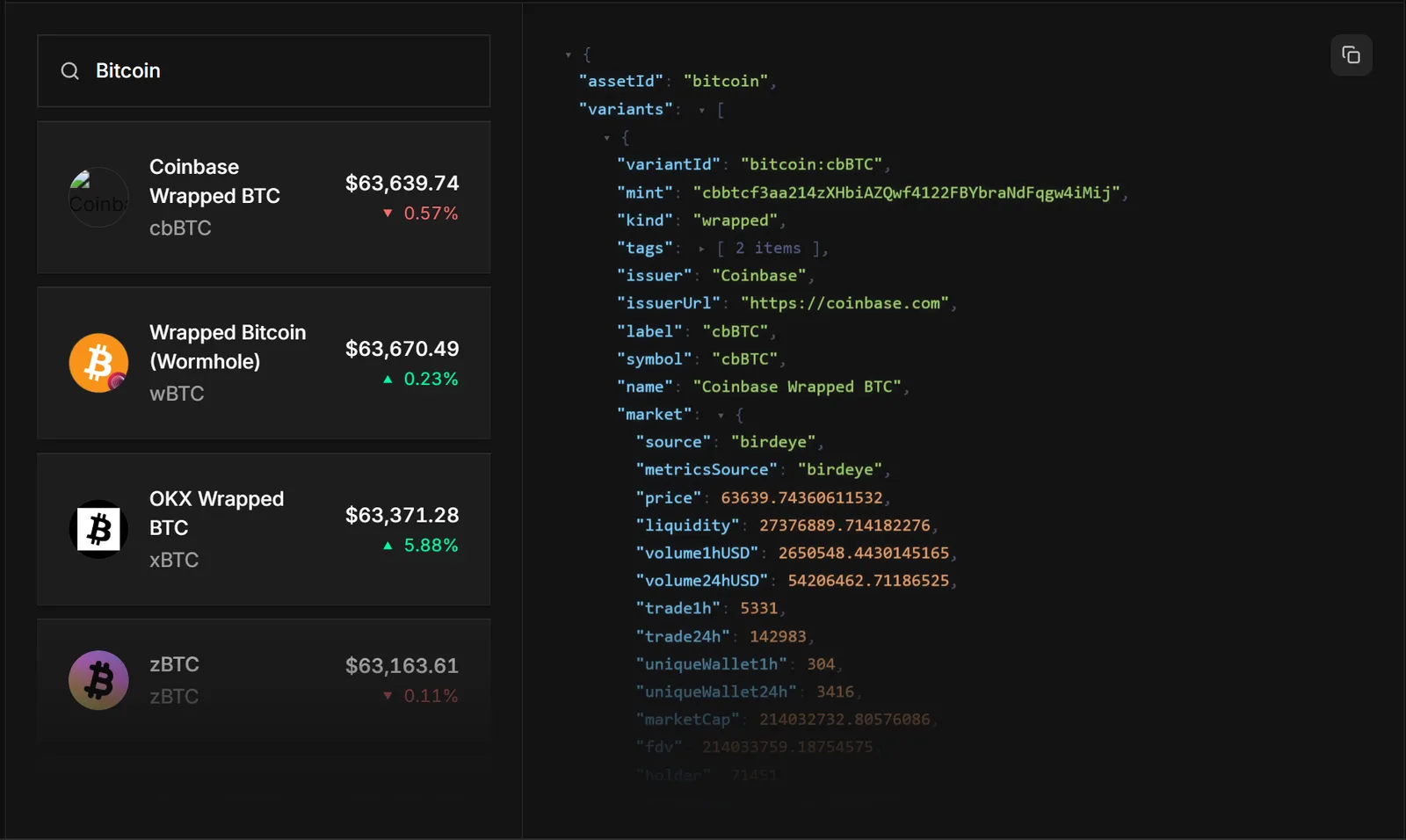
Because there are at least eight ways to hold Bitcoin on Solana, and they don't behave the same. cbBTC, WBTC, xBTC, and zenBTC are all Bitcoin, each issued or bridged by a different party, each with its own liquidity and its own trading activity. Stablecoins fragment the same way. The canonical asset usd resolves to USDC, USDT, and PYUSD. Anyone can mint a token on Solana, so every asset worth holding accumulates wrapped, bridged, and forked versions, along with imitations trading under a similar ticker.
Tokens ranks each asset's variants on a combination of signals: pool size, trading volume, trade count, unique wallets, and the trust and liquidity tiers it assigns. No single number decides the order. A variant can hold deep liquidity and still go a full day with almost nothing trading against it, which makes pool size on its own a bad guide to where an order should go.
tokens.xyz is run as a public good. It has no token, charges no fees, executes no trades, and custodies nothing. It aggregates data and routes users out to third-party venues.
One page per asset, one canonical ID underneath
Most Solana data tools answer questions about a token address. Tokens answers questions about an asset first, then lists every mint that represents it side by side.
Each asset page gathers those variants in one place, and every variant carries its own tags:
Mechanism: what the variant is, one of Native, Wrapped, Bridged, Yield, ETF, or Equity
Trust tier: how much weight to put on it, either Tier1, Tier2, or Experimental
Liquidity tier: how deep its markets are, scored separately from trust, which is how a variant can be large and untrustworthy at once
Issuer: the party that minted or bridged it
The API exposes the same two-level model. assetId is the canonical identifier, a readable slug like bitcoin, usd, or tesla. mint is the base58 Solana token address. Anything Tokens doesn't recognize still resolves, as a singleton asset with the ID solana-<mint>, so an unknown mint returns a usable answer instead of a 404.
How do you start building on the Tokens API?
The Assets API has been in beta since April 2026. Access is granted on request for now, with a wider public launch expected in the coming months. An API key gets you three core queries:
Search: find an asset by name or ticker, which is what you'd wire into an autocomplete box
Resolve: hand it a mint address a user pasted in and get back the asset it belongs to
Compare: pull every variant of an asset with its busiest market attached, so a single request tells you which one to route an order to
Beyond those three, the API returns a letter-grade risk score for any individual mint, price history, and a trending list. Keys are scoped, so one issued for price charts can't read risk data. QuickNode's guide to researching Solana token trades with the Tokens API walks the queries end to end against real assets.
Now that the code is open, you can read how Tokens selects the canonical asset behind a given token. You can also build on it. The Solana Foundation Tokens repo is a working base for your own dashboard, analytics tool, or routing service, already wired to ingest market data and rank an asset's variants, and you can point it at your own data sources or rank on rules that suit your users.
Get started with the docs, repo, and Assets API.