
 Mike Hale
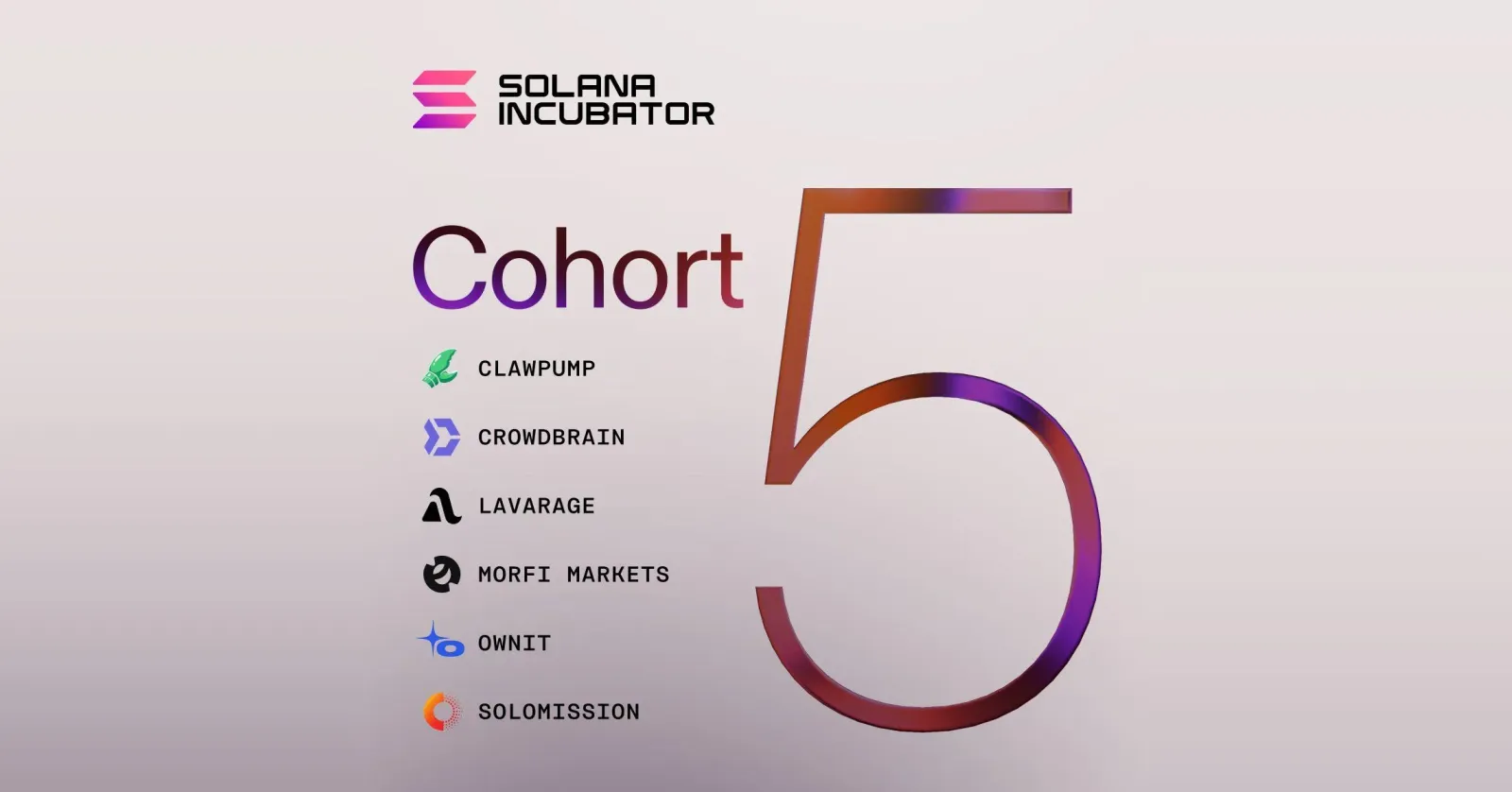
 Solana Labs announced Cohort 5 of the Solana Incubator on September 1, naming six teams that will spend three months building in New York City alongside the Solana Labs team. The group covers robot fleets, agentic finance, spot margin trading, opinion markets, verifiable trade settlement, and a protocol that lets AI agents hire humans.
Emon Motamedi, who heads the program, has described the model as building and growing the companies alongside the teams rather than advising them from a distance.
The incubator takes three kinds of teams:
Existing Solana projects
Web3 teams exploring Solana
Web2 companies moving into Web3
Selection leans on the founders rather than the vertical, and the first cohort drew nearly 300 applications for those handful of seats.
"We look for really incredible technical founders who we think can be the core pillars of our ecosystem 12 months down the road." - Emon Motamedi, Head of Solana Incubator, on Lightspeed
The six teams in Cohort 5
Cohort 5 splits evenly. Three teams build markets, and three build infrastructure for AI systems that need to work with humans or spend money on their own.
Team | What it does | Where it is today |
|---|---|---|
Launchpad for tokenizing and monetizing AI agents | 8,000+ agents, $125M+ volume, 6,000+ SOL distributed | |
Distributed infrastructure for robot learning and operations | Grand champion of the Colosseum Frontier Hackathon | |
Decentralized spot-margin and lending protocol | Live on mainnet, $200M+ volume, 10,000+ traders | |
Opinion market for subjective debates | Live, settles onchain without oracles | |
Verifiable settlement for a multi-billion dollar trading market | Every trade settles on Solana | |
zkFHE proof-of-humanity protocol for agent-to-human work | Backed by Draper Associates |
ClawPump is a launchpad where developers tokenize and monetize AI products and autonomous agents. It has powered more than 8,000 agents, generated over $125 million in trading volume, and distributed more than 6,000 SOL back to creators. Agents deploy with their own Solana wallets and identities, then launch tokens, trade across DEXes, earn DeFi yield, and pay for their own infrastructure out of what they earn. Developers reach it through a dashboard, CLI, Telegram, a desktop app, or MCP connectors.
CrowdBrain coordinates trained humans and robots to handle data collection, teleoperation, evaluation, QA, and deployment support. The team describes itself as a vertically integrated robotics DePIN, training operators in simulation, qualifying them through QA, and routing the best ones to real robots for teleoperation and failure recovery. CrowdBrain won the $30,000 grand champion prize at the Colosseum Frontier Hackathon, which drew more than 10,000 participants and 2,857 final submissions, making it the largest crypto hackathon run to date.
Lavarage is the most established team in the cohort. It has facilitated over $200 million in volume for more than 10,000 traders as a decentralized spot-margin and lending protocol, connecting traders who want leverage with liquidity pools funded by lenders. It has been live on Solana mainnet since early 2024, runs across 700+ markets, and offers up to 20x leverage on hundreds of assets. Its stated mission is driving capital efficiency across Solana, and its practical angle is covering the two things perpetual futures cannot reach: brand-new tokens with no futures market, and tokenized real-world assets where holding the actual asset matters.
Morfi is an opinion market rather than a prediction market. Prediction markets need a verifiable real-world event and an oracle to report it. Morfi settles on where the crowd puts its money, which lets it price questions like "Is Musk good for Tesla shareholders?" or "Should Trump pull out of Iran?" that have no clean external answer. Markets settle onchain without oracles, and a fee on every trade funds the prize pool that winning positions share.
OwnIt describes itself as bringing proof to a multi-billion dollar corner of trading that has always run on trust, with every trade settling on Solana and verifiable by anyone. Its waitlist is open, with a beta launch listed as coming soon. It is the quietest team in the cohort so far.
Solo starts from the observation that agents can think but cannot feel. Its SoloMission product lets AI agents hire humans for taste, judgment, and gut reactions, and its zkFHE proof-of-humanity protocol verifies that each response comes from a unique person. zkFHE combines zero-knowledge proofs with fully homomorphic encryption, so the protocol can confirm a response is real and unique without seeing who produced it. Solo is backed by Draper Associates.
What founders get from the Solana Incubator
The Solana Incubator is a three-month, in-person program run by Solana Labs in New York City for four to six teams per cohort. Participants get a relocation stipend covering the three months in NYC, one-on-one mentorship from experienced founders, weekly business reviews and strategy sessions, and a workshop and speaker series that has included Andreessen Horowitz, Multicoin Capital, and Paradigm.
What past cohorts did with it
Sanctum, Marinade, Crunch, Jito, Drift, Kamino, and Crossmint all came through the incubator. The most recent group, Cohort 4, graduated five teams at its NYC demo day: Coral OS on enterprise AI agent infrastructure, Fractals on the financial layer for physical infrastructure networks, Neutral Trade on institutional-grade quant strategies, Solomon Labs on productive stablecoins and onchain yield, and Spout on fee-free margin trading against tokenized real-world assets.
Across both cohorts, Solana Labs keeps picking teams sitting on the seam between AI systems and financial markets.
Applications for the next cohort open in October
Next cohort applications: October 2026.
Solana Labs reviews applications on a rolling basis and prioritizes early applicants, so the deadline matters less than how soon you get your submission in. The program takes four to six teams a cohort, so the spots are few. Apply through incubator.solanalabs.com.
Cohort 5 puts AI at the center of the businesses rather than on top of a DeFi product. Robots, agents that hold their own wallets, agents hiring humans, and a market that prices opinions all need cheap, fast settlement to work at all, which is a better argument for building on Solana than another DEX is.