
 Mike Hale
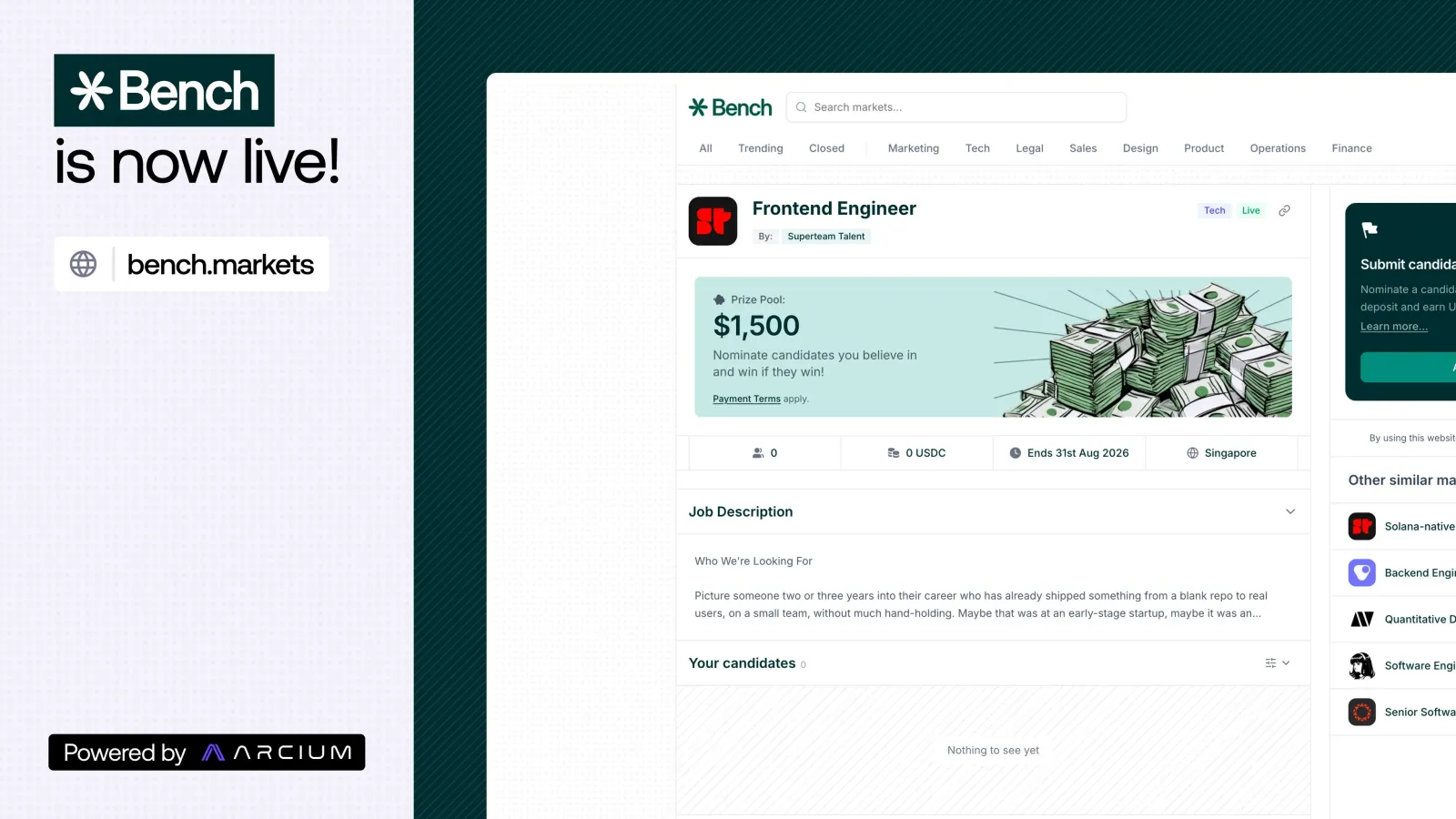
 Bench is a hiring platform on Solana where recruiters and vouchers stake capital on which job candidate will get hired, and the bets stay encrypted until the role is filled. Arcium, the Solana-based encrypted computation network, took Bench to mainnet on August 24, 2026, after running a devnet alpha since April 27 that pulled in more than 4,000 signups in its first week.
Bench calls its format an "opportunity market." A company posts an open role and an optional prize pool. Anyone can add a candidate as an "option" and back that candidate with capital, a step Bench calls vouching. If the company hires that candidate, the vouchers who backed them split the prize pool based on their share of the capital behind that candidate. If not, the staked capital comes back. The one cost that never comes back is the vouch fee. It's a flat 0.7 USDC plus 0.85% of the stake, charged whether the pick is right or wrong.
Bench filters candidates by who the market vouches for: capital and referrals from people with conviction.
— Arcium, Bench launch announcement
Why does a hiring bet need to be private?
Bench's core bet is that a public prediction market makes for a bad hiring signal. In an ordinary market, everyone can see where the money is flowing in real time, so participants pile onto whichever candidate already looks like the frontrunner. That bandwagon effect drowns out the actual information the market was supposed to surface, and it opens the door to front-running. If you already know a company is about to make an offer, adding that candidate and staking on them costs you nothing and reveals nothing new.
Arcium's answer is multi-party computation (MPC), a cryptographic technique that lets a network compute a result over data from multiple parties without any single party seeing the underlying inputs.
Applied to Bench, that means a voucher's stake is encrypted the moment it's placed. Neither other vouchers nor the hiring company can see who is backing which candidate, or how much capital is behind them, until the market closes. Encrypting the price data is what makes it possible to run a market on something valuable enough that revealing it early would destroy the incentive to participate at all.
How does a Bench market work?
Every opportunity market on Bench moves through three phases.
Market creation. The company or market creator sets the title, duration, rules, and the initial prize pool for the role.
Vouching. Participants add candidates as options and deposit capital behind the ones they believe in. Vouches stay encrypted for the life of the market.
Resolution. The market creator picks the winning option, or options, based on which one delivered the most value. Capital gets returned to everyone, payouts within the winning option split by each backer's share of the capital, and the vouches are revealed only after the market closes.
Bench draws a distinction between two market types:
Specific market: Posted by a single company for a role only it cares about, like a backend engineering hire, and that company alone sets and pays out the prize pool.
General market: Created by Bench itself around a question multiple parties might want an answer to, and the prize pool grows with interest the way a price-discovery mechanism would, since more than one company can benefit from the same signal.
At launch, live markets on Bench cover open roles at Solana ecosystem companies including Helius, Ellipsis Labs, Veda, and Nous Research, run in partnership with Superteam Talent. Listed positions span backend and frontend engineering, developer relations, and quantitative development.
Bench takes its own cut only when there's a bounty attached to a role. In that case it keeps 5% of the prize pool, and the remaining 95% goes to whoever backed the candidate who got hired.
The alpha numbers behind Bench
The devnet alpha drew real numbers. By the time it wrapped, 900 unique participants had staked across 12 markets, creating 276 candidate options between them, for a combined stake volume of $7.67 million.
Bench sits on top of Arcium's broader infrastructure. Arcium reached Mainnet Alpha in February 2026, and in June 2026 it launched its $ARX governance and utility token to give the network a native economic layer. The company has raised more than $7.5 million to date and says it supports more than a dozen teams building confidential applications on Solana, of which Bench is the first hiring-specific product to ship.
Bench frames itself as a bet on a bigger idea than recruiting. It's betting that markets, when the price data can stay confidential, are a more accurate way to surface information than the workflows companies already use, whether that's a hiring manager's gut instinct or a sports team's scouting department. Whether that holds up now runs through a much more public test than the devnet alpha did, with real roles, real prize pools, and real capital live on Solana mainnet.
Read More: Introducing Bench: Hiring Markets, Powered by Arcium