
 Mike Hale
 Kamino has launched Kamino Fixed Rates, a fixed-rate, fixed-term credit market built directly into Kamino Lend, with the first loans already originated in private beta and a public rollout planned through Q3 2026. Borrowers can lock a borrow rate for a set term instead of riding a floating utilization curve. Lenders can quote the rate and duration they want while their capital keeps earning somewhere else.
In a utilization-based pool, the rate moves underneath the position. A borrower who opens at 5% can be paying 10% a week later, which makes a spread impossible to model and leverage impossible to size. That's fine for a short, actively managed trade whose economics can absorb it. It doesn't work for a six-month asset position, or for anyone who has to know a funding cost in advance.
Fixed-rate lending on-chain usually breaks on the lender's side. In a standard fixed-rate pool, a lender has to deposit into an empty reserve and wait for a borrower to show up, earning nothing the whole time. Kamino's answer is Conditional Liquidity, which separates the offer from the deposit.
The product is code complete and fully open source, and it has cleared two security audits. Certora reviewed Kamino Lend 1.17.0, and OtterSec reviewed 1.16.0 and 1.17.0. Fixed-rate reserves have been running on Solana mainnet for over eight weeks on Kamino's staging program.
Borrow Intents and Conditional Liquidity
The core of Kamino Fixed Rates is a two-sided order primitive. Borrowers and lenders both get to be makers instead of only takers.
A Borrow Intent is a standing on-chain order. The borrower names the collateral, the size, the maximum rate they'll pay, and the term they want. The intent sits on-chain where lenders and curators can see it, and it stays active until it fills, expires, or the borrower cancels it. Every intent is collateralized at placement. If only part of the size is available, the order partially fills and the remainder stays open.
Conditional Liquidity is the same idea from the lender's side. A vault curator or an individual lender signals the rates, durations, and amounts they're willing to allocate, and the capital backing those offers never moves. It stays deployed in variable-rate reserves, earning yield, until a matching borrower arrives.
When the two overlap, the fill happens atomically. In a single transaction the protocol withdraws the capital from wherever it's currently allocated, deposits it into the matched fixed-rate reserve, and originates the loan. Matching is permissionless, so anyone can submit a fill, and a curator can fill a specific Borrow Intent directly.
How does the yield curve form?
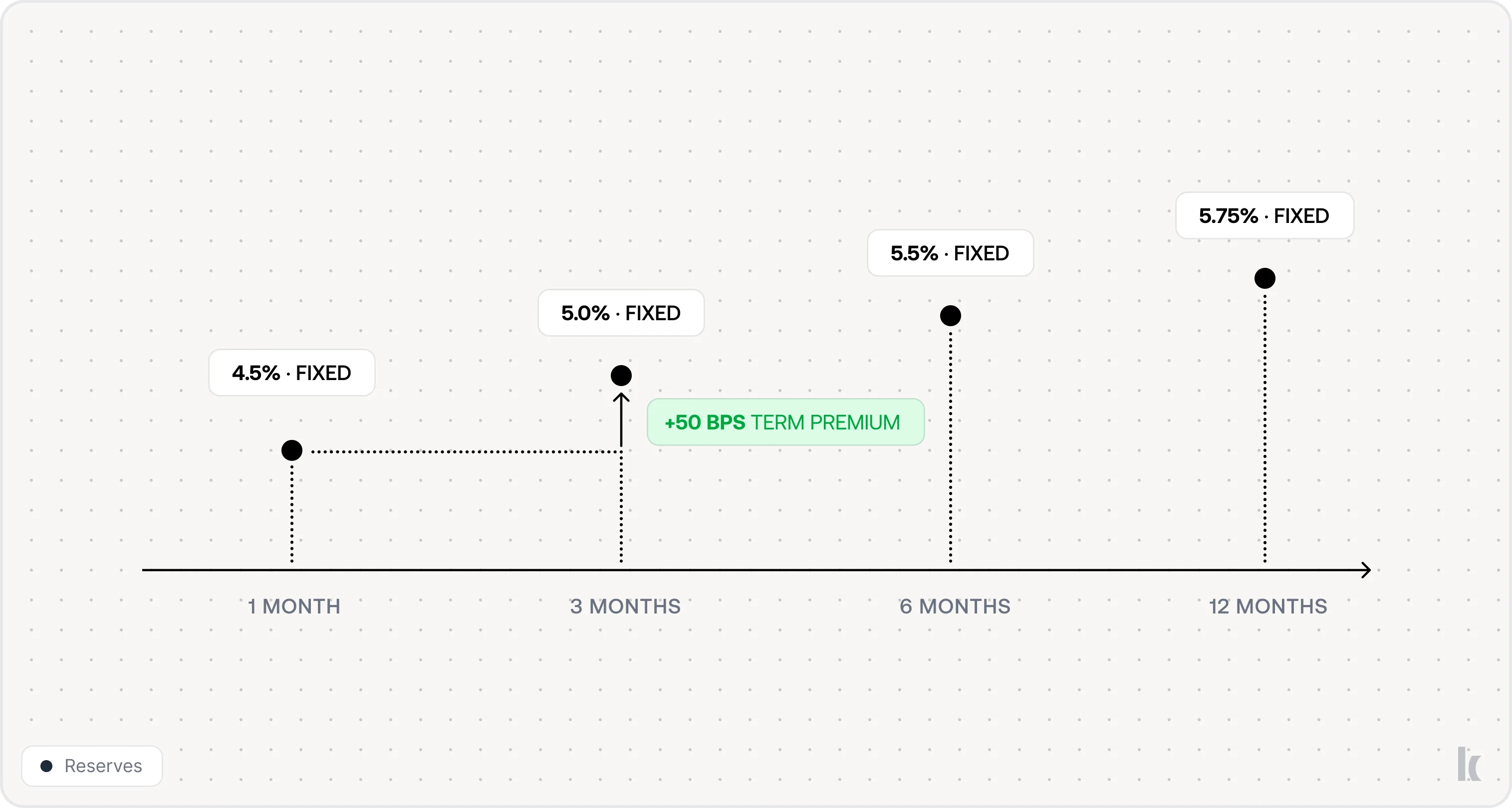
The grid produces a yield curve because each point on it is a real rate that borrowers and lenders agreed to for a stated length of time. Kamino Fixed Rates creates fixed-rate reserves, individual lending pools that each define one specific rate and one specific term. A single asset in a single market can have many of them, forming a grid across every rate and duration combination.
The grid can be created in full before any demand exists, because an empty reserve costs nothing. Lenders and borrowers converge on the reserves where both sides accept the terms, and those reserves fill. The variable-rate pool keeps running alongside the grid, so this is additive rather than a replacement.
Line up the active reserves and you get a curve. The gap between adjacent terms is the term premium, the extra yield lenders demand for committing capital longer. No governance vote or utilization formula sets that number.
What happens at maturity?
Every fixed-rate loan has a maturity date, and the borrower chooses at origination what happens when it arrives. With auto-rollover enabled, the loan renews at the lowest available rate for the same term. If no fixed-rate option works by the end of a configurable grace period, the position migrates into the variable-rate reserve in the same market. Rollovers stay within one market and one asset.
If nothing succeeds and the borrower doesn't close the position during the grace period, Auto-Repay settles it. The protocol seizes enough collateral to cover the debt plus a small fee, clears the debt, and frees the reserve's liquidity. Whatever collateral remains stays with the borrower.
Lenders get a defined way out through the Withdrawal Queue, a first-in-first-out exit on each reserve. A lender who can't withdraw instantly submits a ticket, and tickets process in submission order as repayments, new deposits, or liquidations bring liquidity in. An outstanding ticket also blocks the rollover of maturing loans in that reserve, so the lender's place in the queue outranks the borrower's wish to stay in. That puts a ceiling on the wait, so a lender queuing on a 90-day reserve waits 90 days at most, often less.
Borrowers can repay early, in full or in part, for a fee based on the interest the repaid amount would have earned over the rest of the term. It's largest right after origination and decays to zero at maturity. Kamino says early repayment penalties will be zero or near-zero during the rollout.
Fixed Rates on Kamino Lend
Every component of Kamino Fixed Rates runs inside the Kamino Lend program that's already live, rather than a new one deployed alongside it. That program has 18 external audits, three formal verifications, and three years in production with zero bad debt. Borrowers and lenders trying fixed rates are using the same code that already secures Kamino's existing deposits.
The public rollout starts with a handful of assets and markets and expands through Q3 2026. Institutions after fixed-term financing, asset issuers weighing a dedicated market, fintechs exploring fixed-rate credit, and curators adding fixed rates to earn products can reach out to Kamino.
Read the Lightpaper: Introducing Kamino Fixed Rates